

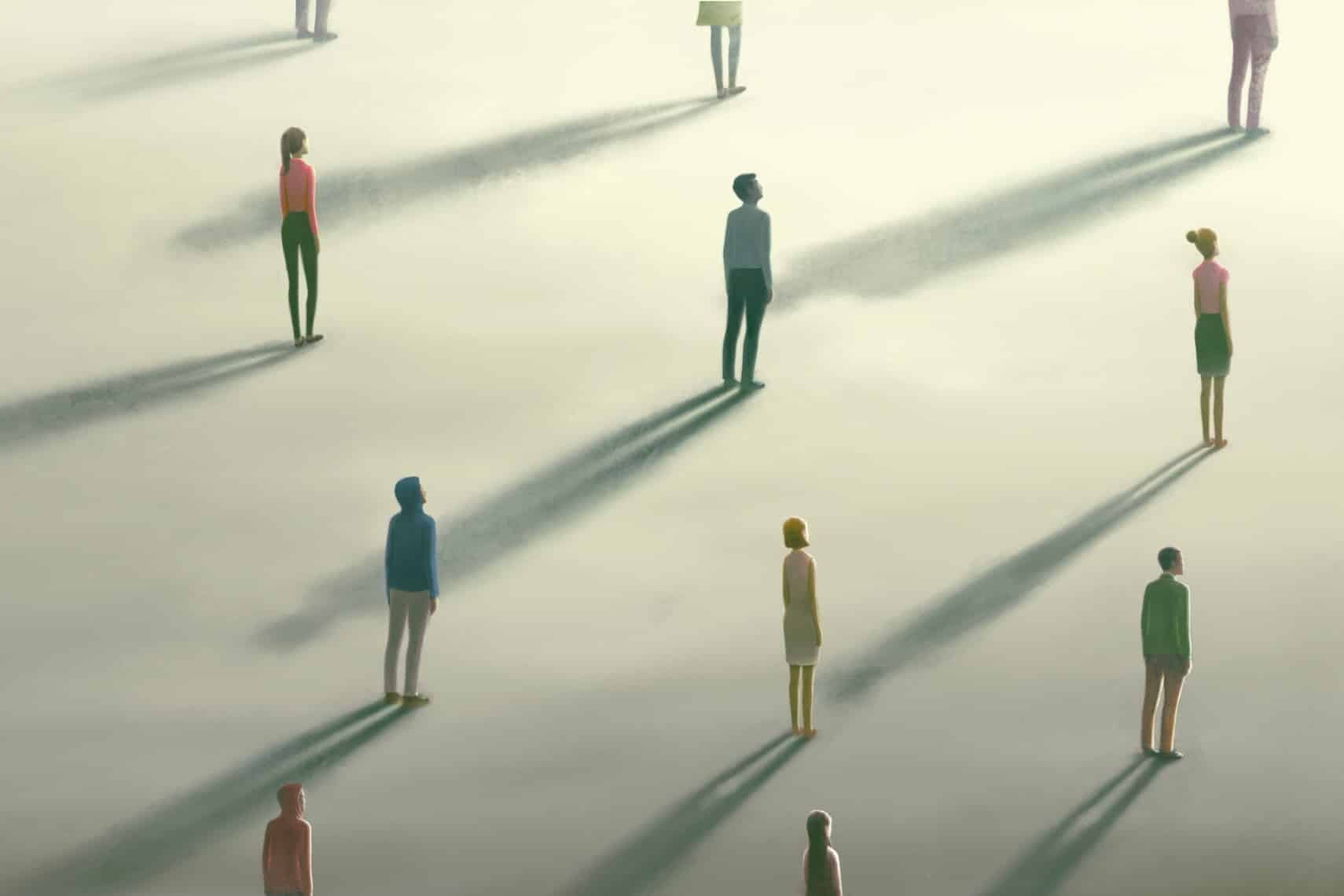
In the modern world, we have turned the simple act of having a casual human conversation into an elite-level logistics problem. We can instantly video-call somebody in Australia, but meeting a friend who lives ten minutes away requires six weeks’ notice, three rounds of cancellations and the signed-and-sealed blessing of both partners.
Avoiding people is easy. You can work an 8-hour shift, come home, order a three-course dinner directly to your bedsit, and stream a foreign film without interacting with another living soul. Okay, maybe your Uber Eats driver, but you still treat him as if he hasn’t got one. “Pedal through the pissing rain with my noodles, my brave little visa applicant.”
As comfy as it sounds, it isn’t. It turns out your body can’t tell the difference between being abandoned by the tribe, and working from home.We are staring down the barrel of a full-blown public health catastrophe. It is called the Loneliness Epidemic, not to be confused with next year’s Morrissey album. It turns out, substituting actual human proximity with algorithmic interaction and inhumane degrees of convenience isn’t just making us sad, it is quietly killing us.
Today, we’re looking at the staggering macroeconomic data, the terrifying biological repercussions of rejection, and why your phone is so good, it’s killing you.
I: The Lonely Crowd
For a long time, society treated loneliness like a personal failure, a niche emotional bummer that you could fix by just “getting out more” or joining a book club. Or maybe you were lonely for a reason. Maybe you’re a freak and nobody likes you.
Loneliness was itself the problem. Today, we know it’s the start of something. The first domino. The eecond domino is ordering a whole Dominos and crying on the bidet.
The scientific establishment has issued a massive wakeup call. According to data championed by the US Surgeon General, the mortality impact of being chronically socially disconnected is the physical equivalent of smoking up to 15 cigarettes a day.
When it was discovered that cigarettes were causally related to serious illness and early death, the government only let them operate for 4 more decades before clamping down. Which, by government standards, is an emergency response. They spent millions running aggressive, multi-billion-dollar global public health campaigns to get people to throw away their cigarettes. We put graphic warnings on packs, we banned smoking in bars, and made smokers (our fellow men) stand outside in the freezing rain just to have a puff. Ironically, it’s now the only place left to make real friends.
Meanwhile, millions of “healthier” people are sitting alone in their apartments, eating quinoa, doing yoga, pristine lungs a-puffin’. They’re dying; their cardiovascular health is actively deteriorating at the exact same rate as a guy chain-smoking a pack of Malboros on their lunch break!
According to extensive meta-analyses tracking hundreds of thousands of adults, chronic loneliness triggers a 29% increase in the risk of heart disease and a 32% spike in the risk of strokes. Broccoli doesn’t hug you. Or, at least, it doesn’t hug you back.
So where are the graphic warnings for loneliness? Where’s the photo on the cat food packet with a single woman, her face devoured by their beloved Mittens?
Prolonged isolation signals to your ancient, evolutionary brain that you have been cast out from the tribe. And in the stone age, being exiled from the tribe meant you were about to be eaten by a saber-toothed tiger. So, your body enters a permanent state of hyper-vigilant biological panic. Your body doesn’t know you’re in a one-bed flat in Basildon. It thinks you’re barefoot in the Serengeti. Your cortisol spikes, your blood pressure goes through the roof, and your immune system drops its guard. “Left on read” is as good as “left for dead.”
“Well, nobody invited us to the barbecue, best find a quiet hole to die in.”
Part 2: Too Much, Too Young
We’ve been told for years that isolation is a pensioner’s bane. But tloneliest demographic in modern society is not the elderly. It’s young adults. The window that grandmother is staring out of? She’s actually watching a much lonelier 24-year-old walk home alone back to his goon cave.
Look at the latest figures from the UK Office for National Statistics (ONS). When they mapped out loneliness by age bracket, they found that 27% of adults aged 16 to 29 report feeling lonely often, always, or some of the time. Compare that to adults aged 70 and over, where that number drops to just 16%. It turns out your nan has a better social life than you, and she still prints emails.
The generation that has never known a world without the internet, the demographic with 5,000 Instagram followers, 300 Snapchat streaks, and a dozen active WhatsApp group chats, is statistically the most profoundly lonely group of humans on the face of the earth. How?
This is the Connected Illusion. We’ve confused access with intimacy. Thousands of followers - not one pallbearer. We built an entire digital landscape that promised ultimate community, but instead gave us hyper-efficient voyeurism. Gen Z isn’t “connecting” on TikTok; They’re spectating. they are sitting in a dark room watching other people live their lives in 15- second loops.. emotional CCTV. A girl in Bali is healing her inner child, a man in Dubai is escaping the matrix, and you’re eating weetabix minis straight out the box, watching them do it
In yesterday’s pants.. Wondering why your life doesn’t look like a drone shot.
And the mental health fallout is staggering. According to the British Association for Counselling and Psychotherapy (BACP), 72% of 16-to-25-year-olds explicitly state that loneliness has a direct, negative impact on their mental health. We’ve given kids unlimited access to everyone except each other.
III: Livin’ In A Ghost Town
So how did we get here? Did we all just suddenly wake up one morning and decide we hated each other? No. That was gradual. Like boiling a frog… or living in Birmingham.
No. I mean, yes, have you seen the general public? One bloke’s licking his fingers before touching every avocado in Tesco. Another woman’s on speakerphone arguing over custody in Boots. You spend ten minutes in a Primark on a Saturday afternoon, misanthropy is the only logical conclusion. But that’s not what happened first. Before that, we systematically dismantled the physical architecture of human connection and replaced it with corporate convenience. We demolished the village… and built an Amazon warehouse.
Sociologists talk a lot about the death of the “Third Place.” Your first place is your home. Your second place is your work. The third place is the anchor of community life: the pub, the church, the football match, the local café, the community hall; the low stakes, shared environments where you hang out without an agenda, nobody was monetising the conversation or building a personal brand, and you could cross paths with people outside of obligation, and engage in standard, unscripted human banter. Remember that?
But look at what we’ve done to the third places:
The Workplace has been replaced by Zoom and Slack. We traded the watercooler chat for a muted microphone and an emoji reaction. The closest thing to office gossip is someone accidentally leaving their mic on while shouting at their kids.
The High Street has been crushed by Amazon. You no longer chat with the local shopkeeper; you receive a silent cardboard box dropped on your doorstep by a delivery driver sprinting to meet his algorithmic quota. Your relationship with your local shopkeeper has been replaced by an email saying, “Your parcel is eight stops away.” You know more about your parcel’s journey than your neighbour’s life.
The Local Pub, a national treasure, is evaporating due to soaring real estate costs and inflation, turning community hubs into luxury apartments for people to sit in... completely alone. “Sometimes you’ve got to live somewhere where nobody knows your name.”
Even when we venture out into public, we shield ourselves like we’re entering a radioactive zone. Look around any underground train cart, bus, or waiting room. Two hundred people… all alone. It’s like a silent disco sponsored by depression. Every single human being has a pair of wireless earbuds jammed into their skull, staring down at a glowing rectangle, checking the same five apps like one of them’s suddenly going to contain happiness sending a clear, universal biological signal to the rest of the species: Do not look at me, do not speak to me, I do not exist in this physical dimension..
We have optimised away the “friction” of human interaction, as if people were buffering, treating conversation like a software bug. completely forgetting that those tiny, friction-filled moments, the awkward smile at a stranger, the little nod men do instead of therapy, the brief chat with the barista are the exact micro-doses of social nutrition that keep our brains from melting.
Our species started this journey in pursuit of convenience and ease,but we kept pushing further. We’ve built a world where we barely need to leave our homes to survive, your ancestors crossed oceans. You won’t cross the road for milk, and we spend more of our lives consuming content than living it.
