

You’ve no doubt heard terms like “bonds” and “bond markets” mentioned in the media but perhaps not really understood what they are. You can be forgiven for this as they are properly boring as fuck, like Triple Lock Pensions, or the Women’s World Cup. Ideally, you should go through life not having to know about them.
Sadly, for those of us in the UK we are likely to become increasingly familiar with the bond market over the near future if many market prognosticators are to be believed. Economists love to make things sound complicated. It seems to be 80% of their job.
However, these shadowy terms are much simpler than they are often made out to be. Which makes the governments’ misunderstanding of them all the more unforgivable. They might not know, but you certainly should.
What are bonds?
The name’s Bond. Government Bond. A licence to bore. Let’s get the tedium out of the way first. And, believe me, it doesn’t get more tedious than this; bonds and debt are probably the most boring area of finance. When we hear media commentators talking about the financial markets, they are typically talking about the glamorous and volatile ‘stock market’. You’re probably imagining sexy swanky Great Gatsby soirees, and men throwing themselves out of sky scrapers. However, whilst stock markets get all the attention and coverage, the bond markets are critically important for our economy, our mortgages and the stability of our governments. So if you’ve got a mortgage, a job, or a Prime Minister you’d like to outlast a lettuce, pay close attention.
So, what is a bond?
A bond isn’t just something a man has with his dog, or a woman has with her crystals. It’s also a debt, – it’s the formal method by which governments borrow money. For example, a national government might issue a bond at say £95 with the agreement that they will pay back £100 to the investor in a years’ time. The investor thus generates a return of 5.26% on his money (£100/95-1). With that money, the government can fund its various projects, in the hope that their return-on-investment can be passed on to the investor who gave them the £95 to begin with.
The investors who make up the bond market are large pension funds, insurance companies, investment funds and hedge funds around the globe. Basically any organisation whose adverts show a silver-haired couple getting handsy on a beach. Once bonds are issued, they can be freely traded (among investors). Think of it as an IOU from the government. An investor holding this IOU can choose to hold it and earn the return over the life of the bond. Alternatively, they can sell that IOU to another investor. This is how our government debt gets traded among international investors.
Bond yields.
You may have heard the term ‘bond yield’ mentioned in the media and been confused as to what they are referring to. Perhaps you’ve heard about them rising and cheered. After all, money + up = good, right?
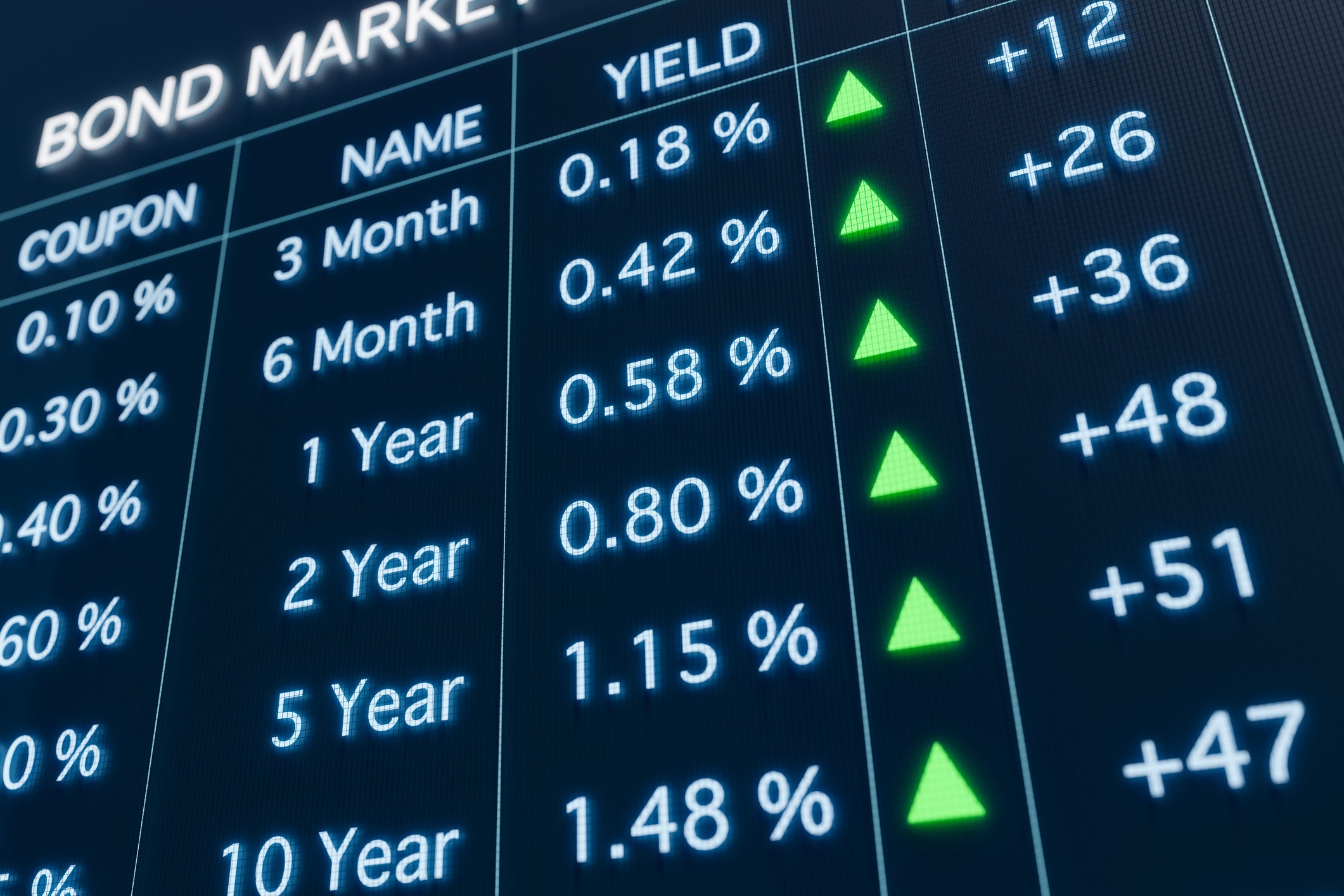
Sadly, in the world of bonds, it’s not so straightforward. The simplest way to think about a bond yield is as the rate of interest on the debt. Rising yields mean that those lending the money are demanding a higher rate of interest to part with their money. The UK’s rising bond yields mean that our government is having to pay a higher rate of interest to convince the world’s investors to lend money to us. Like a street performer who’s gone from juggling to publicly fisting himself just to get the same amount of coins chucked at him.
In our earlier example where we bought a bond for £95 in order to receive £100 back in a year’s time, the 5.26% return we calculated is the yield.
Imagine you’re approached by two of your mates. They each want a short-term loan. You’re a miserable tight git and don’t really care about your friendships so you insist on a bit of interest for the loan. Tom has a steady job, never gets into any bother, irons his socks, and only needs the cash to cover some home improvements. Brian, on the other hand, is a certified cretin - he’s already maxed out his credit cards, hasn’t worked in ages, is on first name terms with all his bookie and is currently trying to pay his electricity bill with scratchcards. Would you charge them both the same rate of interest? Why would you? Who is more likely to pay you back and over what time frame?
This is what bond markets are assessing for countries and companies, and they’re doing it 24 hours a day. For yields to rise, bond prices must fall. Take our example of buying a bond at £95 and earning 5.26%. Let’s say new economic information comes to light which makes us require a higher rate of interest to be comfortable lending money – say 6% instead of 5.26%. The price of the bond will fall to £94.33 which creates a 6% return when the £100 is returned to you. They’ve put a yellow sticker on the country.
So, when you hear a media commentator saying that our bond yields have risen think of it as international investors selling our bonds and our bond prices are falling as a result. Hence rising yields are not a sign of faith in UK: they are the exact opposite. It’s like when your car insurance going up - they’re not congratulating you on becoming a more “exciting” driver.
So, what determines bond prices and bond yields?
Bond investors primary concern is being paid their capital back and over what time frame. They’re uptight like that. You borrow a billion pounds and suddenly it’s all, “Where’s our billion pounds?” When lending to a company, the investor must assess the likelihood of the company being able to pay him or her back in the future. With a government, this risk is low; unlike the rest of us, they always have the Lovecraftian horror option to print more money to fund their obligations.
There are many factors that influence the price and yield of a government bond. However, the most critical are market expectations of inflation and growth, together with the fiscal credibility of the government. This is why historically countries with a record of high inflation and weak fiscal credibility (such as, say, Greece, Argentina and Italy) have had to pay higher yields than those who don’t (i.e., Germany). Germany is a Tom, Italy is a Brian.
Bond markets are laser focused on getting paid back. It’s all they care about, and they act accordingly. With G7 governments, not to be confused with the 50 Cent and S Club supergroup, it’s very unlikely they won’t get their capital back (the £100 in our example) – after all, most governments can just print it if they have to. What bond market participants really care about is what will that £100 be worth in terms of purchasing power when they get it back? If I lend to UK plc at 5% and inflation is 3%, my real return (i.e. my return after the impact of inflation) is only 2%. If inflation rose over the period to 4%, my real return would halve to 1%.
Our example bond was for only 1 year. Imagine you’re lending to a government for 20, 30 or even 100 years and you can see how important it is to understand the likely course of future inflation in that country. In deciding at what yield they are prepared to lend, bond investors are seeking compensation for potential inflation eroding their real returns.
Investors have many potential governments or companies to lend to. Thus, they need to get a return that reflects what they might earn by investing elsewhere, so the price of our bonds reflects what’s on offer by our peer countries.
Who are these investors who have been stupid enough to lend the likes of Boris Johnson and Andy Burnham money?
