

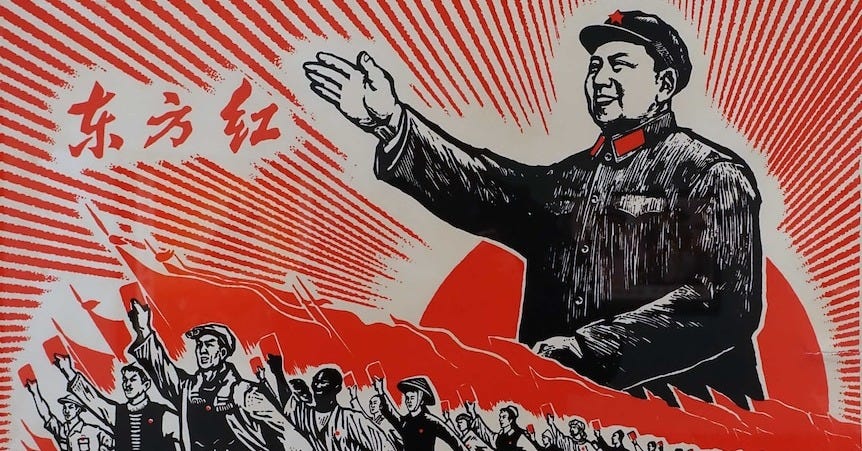
It’s the most enduring romantic fantasy in human history.
No, I am not talking about finding a partner who remembers to put the lid back on the toothpaste; I’m talking about communism.
The political philosophy that simply refuses to die. No matter how many times it’s tried, no matter how many economies it liquefies, and no matter how many millions of people it systematically destroys, it keeps coming back. It’s like herpes, or The Fast and the Furious franchise. And like the Fast and the Furious, each new installment is more costly, makes less sense, and still somehow involves Cuba.
Just when you think, “Surely, we cannot possibly endure another one of these,” a new generation turns up, slaps a sickle emoji in their social media bio, and screams, “But that wasn’t real communism, Francis! Real communism has never been tried!”
It’s the only ideology in history that needs 200 million dead beta testers before the product is ready to launch. Just think of it - the sheer, Olympic-level hubris one requires to look at the trail of hungry corpses that define the twentieth century’s various attempts to secure Marxist nirvana and say,
“You know what? Vladimir Lenin, Joseph Stalin, Mao Zedong, Pol Pot, Nicolae Ceaușescu, Kim Il-sung, and Robert Mugabe, maybe they all just lacked my specific nuance. If I had been in charge of the agricultural collectivization of the Ukraine in 1932, they’d be dying of obesity in satin beds instead of malnourishment in bread lines, and the aesthetic would have been brilliant.”
The only thing standing between Stalin and utopia wasn’t economics. It was Poppy from Surrey’s 2:2 Sociology dissertation.
It is an extraordinary delusion. According to the most conservative demographic and historical consensus, including data compiled in The Black Book of Communism by Harvard University Press, the twentieth century death toll of communist regimes sits somewhere between 85 million and 100 million people. I’ll say that again—between 85 million and 100 million people. A couple of teething issues. Nothing a few minor tweaks couldn’t fix.
That’s the equivalent of wiping out the entire modern population of the United Kingdom, plus the entire population of Australia, and then and then looking at Denmark and thinking, “Fuck it.” That is not a hiccup. That is not ‘a poor policy’. That is a century-long human meat grinder, running at all costs. That is the policy.
Yet, if you walk onto a university campus or have a scroll through TikTok today, you will find a thriving industry of wealthy, Western, upper-middle class influencers, whose only experience of famine is a 16:8 intermittent fast, getting all misty-eyed at the prospect of gulags and death marches. They see the Soviet Union like it was a historical Glastonbury only with more queues and, admittedly, better toilets.
We have entered the era of the Champagne Bolshevik. The revolution will begin immediately after brunch. No gluten, obviously.
The generation that hates capitalism so passionately, they take to the airwaves to stream their outrage twenty-four hours a day, deploying an electronic device built by slaves while telling you that Global South exploitation must end. Distributing their diatribes over Wi-Fi provided by the free market they’re trying to abolish, adorned in a $1,200 designer t-shirt that was shipped to their luxury apartment with Same Day Prime delivery. The revolution has never had better broadband. Workers of the world, you-like.
II: What It Is (And Why The Kids Love It)
The young comrades that make up the modern Left seem to think Communism was invented by a trendy graphic designer on Pinterest in 2018. As far as they’re concerned, Marxism began when someone put “tax the rich” on a dress, and charged $18,000 for it. Ironically, tax deductible.
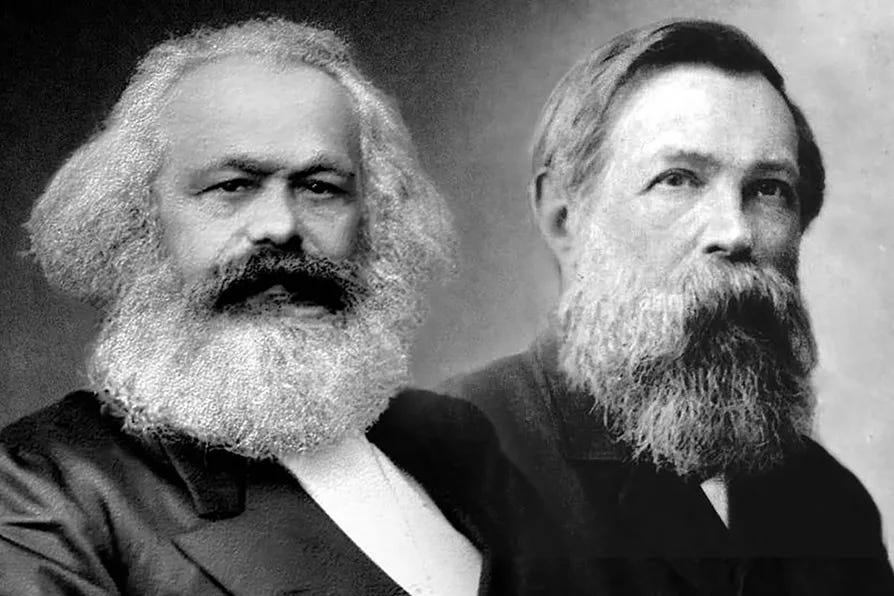
The concept traces back to the 1840s, entering the public consciousness in 1848, when Karl Marx and Friedrich Engels published The Communist Manifesto. Marx, famously, never held a job and sponged off Engels for decades; he literally needed a sugar daddy to abolish capitalism. The two argued that all of human history is defined by a class struggle between the bourgeoisie, the wealthy who own the factories and the land, and the proletariat, the working class who sell their labor. To break the cycle, the workers must violently overthrow the owners, abolish private property, seize the means of production, and hand everything over to the state, which would temporarily manage society until the state magically withered away into a classless, moneylender-free paradise. Don’t worry. The state will manage everything temporarily.
Like airport security. Like emergency Covid powers. Like the BBC licence fee. Like income tax.
This, the writers thought, was the inevitable result of capitalism. Their followers couldn’t be bothered to wait around.
It sounds deeply altruistic when you’re reading it in a university library. In practice, it’s a paradox. The classless society requires a ruling class. It might not be a monarchy or a democracy, but someone needs to be in charge. To make sure everything’s divided evenly, and that nobody overthrows the communist system. And once that’s installed, then what?
The state never withers away. The state is your mate saying he’ll only crash on your sofa for a couple of weeks. Twelve years later, he’s still borrowing your phone to check his ex’s Instagram Stories, whines about the thermostat settings, and has killed all of your most productive farmers.
When you give a centralised bureaucracy total control over food, shelter, jobs, and life itself, you don’t get a paradise. You get HR with Nuclear deterrents. You get an all-powerful, totalitarian regime that has to build walls and gun down its own citizens to stop them from fleeing the workers’ utopia.
And we’ve seen it time and time again. Remember that 85 million number? That’s not collateral damage. That’s the brochure. That’s how many fell into the jaws of totalitarian murder in the pursuit of vegan buffets, drum circles, and open mic poetry.
Yet, despite this unblemished track record of absolute failure, we keep leaping into the jaws. Specifically, young people. And if you think it’s just a few edgy teenagers on the internet, you aren’t paying attention to the actual data.
Look at the political trends over the last few years. Polling from organizations like the Institute of Economic Affairs found that a staggering 67% of young people in the UK say they want to live under a socialist economic system, with a significant portion openly identifying capitalism as the source of all modern evil. Despite it being the reason they can get a Deliveroo, vape, and a weighted blanket delivered to their anti-capitalism hug-box.
Ironically, that sentiment has created a massive, highly profitable industry of radical political consumerism. Walk around London or any major university town, and you will see advertisements for Marxist Walking Tours, where young people pay £20 a ticket to walk past historic capitalist banks while listening to a guide explain why money shouldn’t exist. We’ll finish in the gift shop. Capitalist currency pays a commercial business for a guided penny-dreadful through the evils of commerce.
Egg on face, while we still have either.
We see membership numbers spiking for organizations like the Socialist Workers Party and radical youth communist leagues. Week-in and week out, you can find twenty-one-year-olds standing on high streets outside tube stations, eagerly handing out copies of The Socialist Worker with the same predatory energy as a religious cult or a multi-level marketing scheme selling weight-loss shakes.
And why are they falling for it? Because the human brain is hardwired to love a shortcut. Communism promises an end to the brutal, exhausting anxiety of the capitalist marketplace. It converts the natural, healthy frustration of youth into a religion of institutionalized envy. It hides the gulag behind a wall of promised utopia.
III: The Law of the Vital Few
Don’t shoot the messenger. It’s not my fault that the communist dream of absolute equality always shatters upon impact with reality. It’s basic arithmetic. It turns out, the universe does not care about your manifesto. Gravity, to my knowledge, has never once attended a diversity workshop.
There is a mathematical law in economics and nature known as the Pareto Principle, or the 80/20 rule. Discovered by Vilfredo Pareto, it states that in almost any system, roughly 80% of the consequences come from 20% of the causes. Twenty per cent of your apps use eighty per cent of your battery, twenty per cent of your friends are responsible for eighty per cent of your regrets and that one crazy girl you brought home one night is responsible for 80% of all the terrifying texts you get. It’s maths.
The reason nobody is listening to your avant-garde podcast about post structuralist poetry hosted by you and three people all called Rowan isn’t because the capitalist bourgeoisie is actively suppressing your signal, it’s because the Pareto distribution dictates that a few entities will always capture the vast majority of the audience’s attention. It happens under every system.
It’s also completely outside of our control; the fatal arrogance of the Soviet Union was believing they could legislate this law of nature out of existence. They looked at human nature and went, “nah, fuck this right off.” When Vladimir Lenin and Joseph Stalin liquidated the Kulaks, the relatively wealthy independent farmers during the early years of Soviet rule, they claimed they were destroying a corrupt class of capitalist oppressors.
But they weren’t destroying an artificial political class; they were destroying the top 20% of the farmers who produced 80% of the agricultural output. You can redistribute land. You can’t redistribute competence.
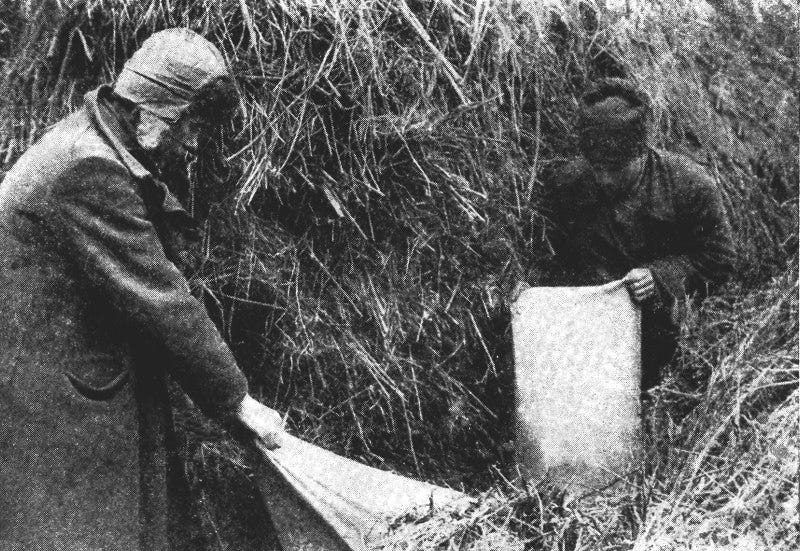
Because even in a group of entirely socialist farmers, the Pareto distribution still applies. Some farmers are naturally more competent, some are harder working, some have slightly better soil, and some don’t spend their afternoons drinking dirty-bathtub moonshine.
When the Soviet state shot or exiled that productive 20% in the name of “fairness and equity,” what happened? The remaining 80% didn’t magically step up production. Why would they? So they could be liquidated too? Congratulations, Comrade Ivan, you grew the most potatoes this month! Employee of the Month. You’re fired. It’s like that Rush song about the trees - “And the trees are all kept equal, by hatchet, axe, and saw.” They couldn’t create excellence. They could only punish it.
The entire agricultural system collapsed, resulting in the Holodomor, the catastrophic man-made famine where over 3.5 million people starved to death in Ukraine alone.
They could only fix inequality by making everyone equally hungry.
IV: Lessons from Venezuela
Let’s leave the air-conditioned penthouse rooms of West Hollywood and the Marxist walking tours of East London where revolution always finishes with a Q&A in a coffee shop, and look at the real-world stakes of this ideology. And I’ll admit, this is deeply personal for me.
As I might have mentioned, my mother is from Venezuela. I have watched, in real-time, over the last two decades, as one of the wealthiest, most resource-rich nations in South America, a country sitting on the largest proven oil reserves on the planet, was systematically brought to its knees by the “Chávista” socialist revolution.
Today, more than 7 million Venezuelans have fled the country. That is a refugee crisis larger than Syria’s, generated entirely by economic mismanagement and ideological arrogance. Seven million people don’t abandon their homes because “the vibes were off”.
And if you want to know how the system truly treats the working class, you only have to look at how it responds to natural disasters. Just recently, northern Venezuela was struck by a catastrophic doublet earthquake, a 7.2 magnitude foreshock followed 39 seconds later by a massive 7.5 mainshock. It was the strongest seismic event to hit the country in 125 years.
The official statistics from the ground are horrifying. Over 1,700 people are confirmed dead, thousands are injured, and more than 46,000 people are currently missing beneath the rubble in Caracas and La Guaira.
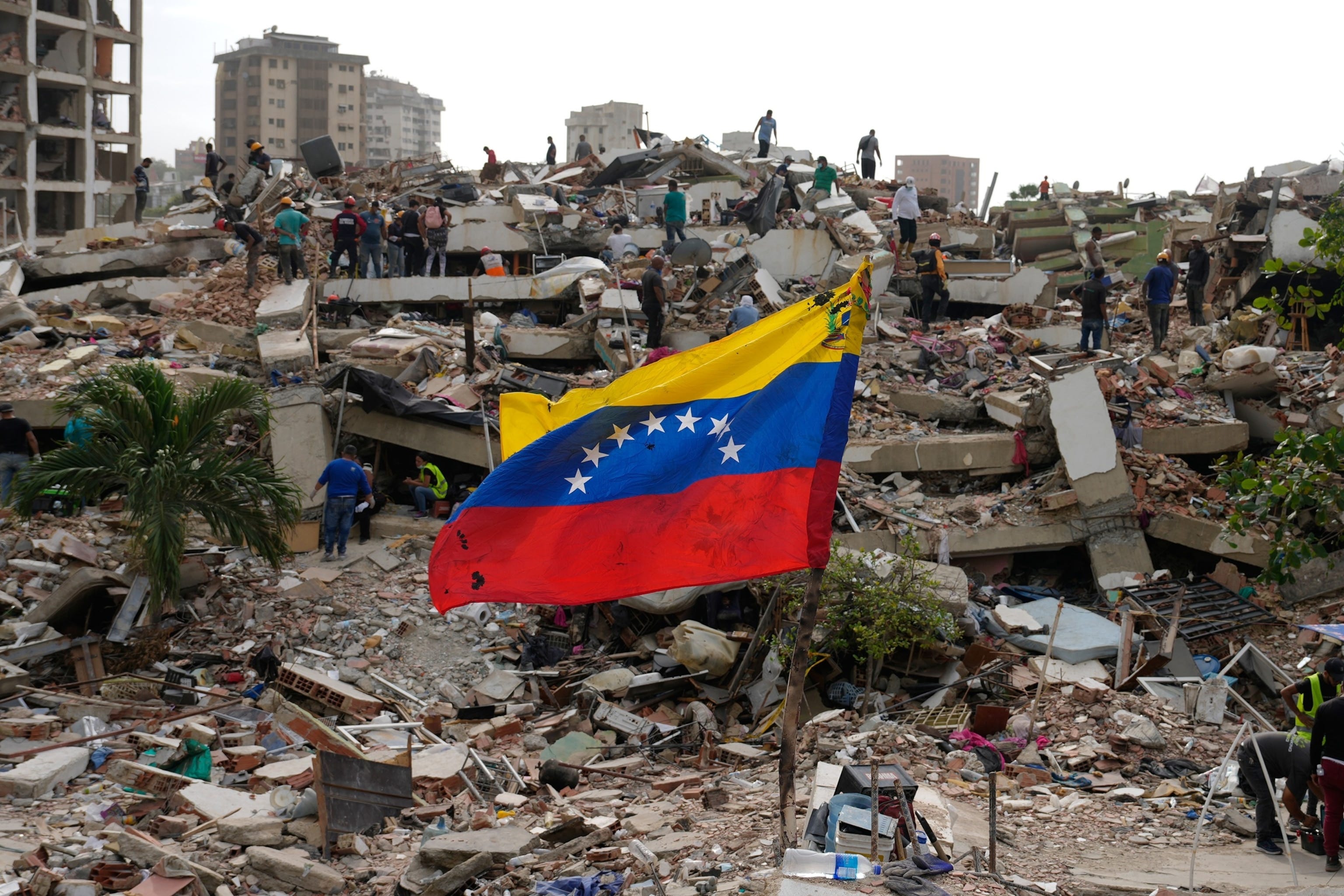
Venezuela didn’t collapse because of a sudden, unpredictable shift in tectonic plates. It collapsed because the state nationalized the industries, destroyed price mechanisms, printed the currency into oblivion, and replaced competent engineers with loyal party bureaucrats.
And when a disaster like that strikes a socialist state, who pays the ultimate price? It is always, without exception, the poor who get the worst hand.
While the ruling elite, the military generals, and the “Boligbourgeoisie” live in reinforced luxury villas in protected pockets of the capital with private generators and imported food, the working class live in poorly constructed, concrete-brick houses stacked precariously on the hillsides of barrios like Petare. Socialism always promises to abolish class. What it actually does is make the class system more apparent. When the earth shakes, the hillsides liquefy, and the homes of the poor collapse like stacked cards. Why? because twenty years of state corruption means there are no building codes, no infrastructure investment, and no functioning emergency response. Concrete can’t “identify” itself into structural stability.
When the Red Cross and humanitarian teams arrived on the ground, they found hospitals without running water, without antibiotics, and without basic trauma supplies. This isn’t because of the natural disaster; the hospitals were empty before the earthquake.
That is the true face of the ideology that Western influencers romanticize on Twitch. In West Hollywood or Brixton, communism is an edgy lifestyle brand, like being into crust-punk or New French Extremity. In Caracas, it’s a collapsed roof over your head, and an empty medicine cabinet. It’s the death of your family and friends. But that doesn’t look good on a shirt.
VI: The Only Real Alternative
I’ll concede that capitalism isn’t perfect either. Like communism, it’s backed by beautiful, well-intended principles that, in practice, don’t always create the most desirable outcomes. For most of us, it’s a rat-race where the cheese is dynamically priced. Very little is guaranteed and your life is defined by your work. It’s inherently inequitable, often ruthless, and produces an ambient anxiety that’s so omnipresent, it’s easy to forget it’s even there.
It’s no surprise that people go looking for an alternative. But if communism is a catastrophic human meat grinder and capitalism is a hyper competitive, high-stress casino that leaves people feeling alienated, overworked, and broke, what do we do? Other than become a Labrador.
Winston Churchill captured the brutal, unvarnished reality of the democratic-capitalist condition perfectly in his famous 1947 address to the House of Commons.
“Many forms of Government have been tried, and will be tried in this world of sin and woe. No one pretends that democracy is perfect or all-wise. Indeed it has been said that democracy is the worst form of Government except for all those other forms that have been tried from time to time...”
Which is the most British endorsement of anything, ever. It’s shit, but it’s the best we’ve got. Capitalism, for all its faults, has one mathematical, foundational saving grace that no collectivist regime can ever replicate: It is the only system in human history that treats you like an individual. One with choices, agency, and unique attributes.
Under capitalism, you can fail. Often through no fault of your own. But at least nobody made you fail. At least, the universe’s whims stitched you up, not the government’s. Adam Smith - the theory’s main man - famously said that poverty was a state of nature. Even at its worst, capitalism is only as bad as no system at all. Communism, on the other hand, is worse; it takes from you the things that you made yourself.
Under a capitalist system, you have the freedom to be a complete hypocrite. And millions do. You have the right to log onto a corporate social media platform, access high-speed privately owned broadband, wear an expensive designer garment, and spend your evening selling the concept of Marxist revolution. It’s the only ideology confident enough to stock its own critics. Waterstones has a Marx section. Pyongyang does not have an Adam Smith table. Freedom is weird like that.
But history has proven, with terrifying, bloody consistency, that the moment you trade that flawed individual freedom for the grand collective fantasy, the trap snaps shut. The utopian vocabulary evaporates, the borders are locked, and the tyranny begins.
The next time you see a young person standing outside a tube station handing out communist leaflets asking if you’ve got a minute to abolish private property, or a multimillionaire streaming from a luxury gaming chair about the glory of wealth redistribution, look past the aesthetic. Peel off the sickle emojis and smack away the designer berets.
Remember the empty hospitals of Caracas, remember the liquidated farms of Eastern Europe, and remember that the most valuable thing you own isn’t the means of production—it is your right to stand up, go nose-to-nose with the people in people, and say “No.”
If you enjoyed that, order my new book - (Un)educated - and subscribe to my YouTube channel.
Maybe I should become a Labrador🤔
Jokes aside, excellent piece my man, funny to boot, but brutally accurate for it, too.
As Frank Zappa once said, “communism doesn’t work because people like to own stuff.”