

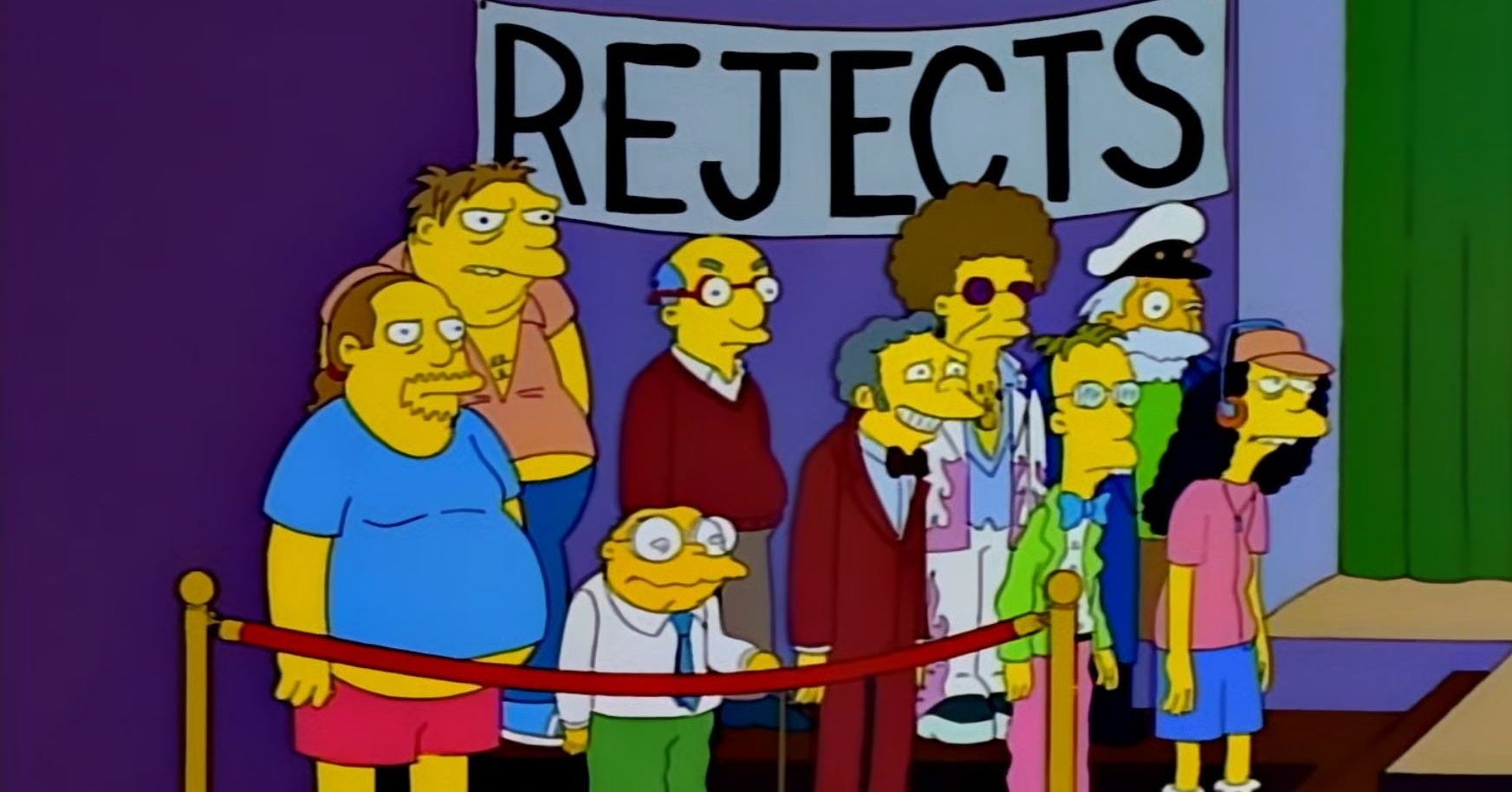
Human connection is the bedrock of our species.
It’s the reason we build civilisations, write songs, weave matching underwear, and feign sustained interest in photographs of someone else’s childhood caravan holiday to Cornwall. Oh wow, a seagull ate one of your chips in 1993? Please, keep talking, I am riveted.
Finding your person is a majestic, life-affirming journey. But we’re not talking about them today; we’re talking about the survivors. Or, rather, the casualties. The eternal bachelors. The Cuppasoup market. The people who, through a divorce, a long-term relationship collapse, or simply because they spent their twenties and thirties prioritising their career over human replication, or due to plain-old-fucking-about, find themselves back on the open market after the age of 40.
And dating after 40 is not a chic, high-end cocktail mixer. It is the final, desperate hour of a rainy car boot sale in a muddy field in Kent or rural Ohio for our American viewers, where everything good is already packed away in the back of someone else’s Nissan Qashqai.
You got there late, and you’re going home either empty-handed or in a relationship with a decorative samurai sword, which is not getting anyone laid.
If you attend a car boot sale at 7:00 AM, you get the pristine antiques. You get the unblemished vintage watches, the mint-condition vinyl records, the solid oak furniture. In human terms, those are the emotionally regulated singletons. The ones with secure attachment styles, functioning boundary systems, and zero unaddressed childhood trauma.
But those people were bought and paid for decades ago. They were snapped up at 8:15 by savvy shoppers who knew what they were doing. They are currently at home, happily married, arguing about the dishwasher, and permanently off-the-market. They are eating pesto pasta in matching dressing gowns, and they are never coming back for the rest of us.
When you arrive at the romantic marketplace at 4:30 in the afternoon, the vendors are already packing up their damp tarpaulins. The rain is coming down sideways, and the trestle tables are adorned in unwanted leftovers. A single, left-footed Dunlop wellington boot filled with stagnant rainwater. A cracked ceramic mug commemorating the 1981 Royal Wedding. And a VHS copy of Basic Instinct you take home, only to find the one scene you wanted has been warped beyond all recognition into a sort of flesh-coloured Rothko.
We are all the damaged goods left on the table. And I am not excluding myself from this thesis. I, despite my efforts, know exactly what I am: a tired, 42-year-old man whose knees sound like bubble wrap when I use the stairs. If I were a car boot sale asset right now, I’d be an old, heavily dented kettle with an unreliable whistle and a severe limescale problem. You’d look at me and think, “That might still work... but do I need to be the one who finds out it doesn’t?”
The tragedy of midlife dating is that we are all standing in this muddy field, staring at each other’s cracked porcelain and missing gears, desperately pretending we’re browsing a premium antique showroom.
They desperately don’t want you to know that.
I: The Showroom Illusion, And The Maths Behind The Misery
In the old days, dating had a natural, organic rhythm.
You went to a pub, you drank four pints of sub-standard lager, you looked across a sticky carpet, and you made awkward eye contact with someone with a terrible haircut. Today, the entire infrastructure of romance has been outsourced to a digital monopoly designed by tech executives in California.
According to the Pew Research Center, around three in ten US adults have used a dating app, but among people who are single, the proportion is far higher. More importantly, look at who owns the architecture of modern love. A near-total monopoly exists. A single corporate entity, The Match Group, owns Tinder, Hinge, Match.com, Plenty of Fish,OkCupid, and even BLK - the #1 dating app for Black singles. They control the distribution of human intimacy. They’re basically the East India Company, but for getting ghosted by fuckboys, and their entire business model hinges on a lie…
The Illusion of Infinite Supply.
When you are physically standing in that muddy field at 5 o’clock in the afternoon, your human brain looks at the remaining cars and understands the reality of scarcity. You adjust your expectations. You look at a wicker basket and say, “Well, the handle is slightly loose, but with a bit of wood glue and some effort, it could hold my potatoes.”
The dating apps don’t give you all the information. You can’t see how many cars are left. The Match Group’s algorithms are intentionally calibrated to keep you swiping. Economists call this the “Choice Overload Effect.” A famous study by psychologists Sheena Iyengar and Mark Lepper—often called the “Jam Study”—proved that when consumers are presented with 24 choices of jam, they are dramatically less likely to make a purchase than if they are shown only 6 choices. When you give the human brain infinite choices, it paralyzes the decision-making process. The apps exploit this by whispering in your ear that right behind that wicker basket with the loose handle is a hidden, magical warehouse containing ten million perfect, flawless wicker baskets that are hotter, richer, and live exactly 1.2 miles closer to your flat.
Sociologists analysing data from apps like Tinder have found a small number of profiles get most of the attention, while everyone else competes for relatively few matches. It is romantic feudalism. We are the peasants fighting over a mouldy turnip while a 26-year-old crypto-bro named Brayden hoards all the supermodels. Fuck you Brayden, rich and handsome bastard.
These platforms are built entirely for high-speed, superficial visual appraisal. They are designed for twenty-two-year-olds whose faces haven’t yet been subjected to the relentless downward pull of gravitational forces, corporate stress, and decades of societal disappointment, and starting a controversial political podcast.
When you are 43, your face tells a story. It’s a complex narrative involving two redundancies, three lockdowns, a few global wars, an interest rate spike, and fifteen years of wondering why your lower back hurts when you sleep on a mattress that isn’t firm enough, or one that’s too firm, or even just right - it will kill you.
Anyhow, that does not translate well to a 200-millisecond left-or-right swipe decision while someone is sitting on the toilet. Romance has become something somebody decides between a sudden bout of explosive diarrhoea and loading up Wordle.
The system is broken, users are forced to turn their entire human essence into a corporate sales pitch. Have you looked at over-40 dating bios recently? They are an absolute graveyard of human copy-pasting. Every single profile is identical.
If I see one more profile from a forty-four-year-old corporate compliance officer stating that they “love travelling, Friday night margaritas, country walks, and are looking for a partner in crime,” I am going to throw myself into the Thames.
A partner in crime? What crime are we committing at our age? Putting the wrong plastic in the blue recycling bin? Sneaking a bruised peach through the Waitrose self-checkout? We aren’t Bonnie and Clyde. If we commit a crime together at age 45, our primary operational concern will be whether the getaway vehicle has heated seats and adequate lumbar support.
II: What’s Really Left On The Table
At a car boot, everyone’s looking for the same thing: The Unopened Project.
On paper, this person looks like an absolute miracle. You find a profile and think, “My god, look! Good looking. No ex-spouses, no complex custody arrangements, no shared mortgage. They’ve made it to 42 completely unencumbered!” But beware. The Unopened Project is the human equivalent of a 1990s flat-pack wardrobe still inside its original cardboard wrapping. You think it’s pristine, but the moment you open it, you realise the glue has dried out, the dowels are missing, and it has spent twenty years developing a highly specific, totally inflexible way of existing. If you ask them to support you, they will violently collapse.
If someone reaches their mid-forties and has never had to compromise on which way the toilet roll faces, they’ve had sole executive control over the thermostat for twenty years. hasn’t had to endure a single family Christmas with a mother-in-law who judges their gravy-making abilities, they are functionally untrainable. They are, and I say this with love, functionally feral. They are not single; they are undomesticated.
Right next to those kinds of people on the table, you find an even more dangerous category: Spares and Repairs Only. These are the traumatised survivors of the Great Relationship Wars of your thirties. Data shows that the average age for divorce in the UK and US sits precisely between 40 and 45. This means the over-40 dating pool is heavily populated by people who have just been through the multi-year emotional and financial meat grinder of a bitter legal separation.
And many of them don’t want a new partner. They say they do, but not really. They want an unpaid, pro-bono therapist, or an accomplice to help them commit administrative revenge against their ex.
They want an audience. Someone to hear, for the eighteenth time, why Michael’s solicitor was “an absolute giga-whore.”
Their dating profiles are built like defensive military architecture. They write things like: “No drama. If you don’t know what you want, swipe left. I know my worth.” The moment someone writes “I know my worth” on a dating profile, you know exactly what they are worth: approximately three weeks of intense emotional labor followed by a sudden Sunday night text message explaining that they “aren’t ready for anything serious right now because their energy fields are misaligned.”
Or Mercury is in retrograde. It’s amazing the things you ladies will blame on a planet 48 million miles away.
They are flashing their hazard lights before you’ve even turned the ignition key. And just to be clear to the men watching, this is us as well, I know a few spares and repairs only myself.
And finally, ooh finally, you have the most tragic category of all: The Missing Components. These are the people who seem genuinely flawless. They are charming, successful, attractive, and contextually hilarious. You go out for dinner. The conversation flows. You laugh at the same jokes. You start secretly calculating what you might name your future golden retriever.
Then, right around the arrival of the second glass of Pinot Grigio, the missing component reveals itself. They casually mention that they still live with their ex-spouse or that they aren’t technically divorced, Or they casually mention the mild inconvenience that they actually live in Australia. True story.
And all of this would be amusing if the targets of this market weren’t real. Lonely people suffering from what I call The Paradox of the Bagged Item. When you buy something at a car boot sale early in life, you take it home, you clean it up, and it integrates into your house. It becomes part of your domestic landscape. But when you try to integrate a new human being into your life after 40, you aren’t just bringing home a new item—you are trying to jam an entire, fully formed, highly opinionated household into an already crowded room.
By 40, we are all carrying an immense amount of luggage. And it’s not neat, matching luggage either. It’s those massive, blue checkered IKEA bags that are splitting at the seams, held together entirely with duct tape, resentment, and hope.
We know this about ourselves, and we know it about each other. So we don’t go in with our hearts open; we become romantic auditors. Psychological studies on midlife dating behavior show that older singles display significantly higher rates of “relationship skepticism” than younger demographics.
And that makes sense because we’ve been burned. We sit across from a potential match, and instead of listening to their stories, we are running a risk assessment matrix in our heads. We’re not on a date anymore; we’re surveying the site in hard hats.
“Ah, they mentioned their mother three times in the first ten minutes. That indicates an unresolved attachment dependency.”
”They didn’t offer to split the bill, which implies an entitlement complex.”
”Asked the waiter for the wifi password - needy.”
”They use an Android phone; clearly, they are a psychopath.”
We are so busy looking for the cracks in the porcelain that we don’t even notice if the item can still hold water.
III: Facing Facts
