

Hello reader. This article is part two of a furious screed on the subject of subscriptions, tech supremacy, and the atomising effect of disownership. I recommend you read the first part before you get ‘round to this one.
Done that?
Lovely. Let’s crack on.
Part 4: The Hardware Hijack
Everything we have discussed so far—as invasive and irritating as it may be—has largely existed in the digital world. It’s software, streaming services, cloud storage. And however much I may dislike some of it, I can at least understand the economic argument. Netflix today is a different service to what it was a year ago, and you’re paying for those updates along the way. I wish I didn’t, but I can accept those terms.
But that wasn’t enough for the fat cats. Corporations looked at the physical world - actual objects made of metal, plastic, leather, glass, and copper wiring - and asked a question so breathtakingly audacious that it deserves to be framed and displayed in a museum of pure corporate villainy: “What if we made them pay every month for a thing they already own?”
A business model only previously attempted by the Mafia.
Nobody did it better than BMW.
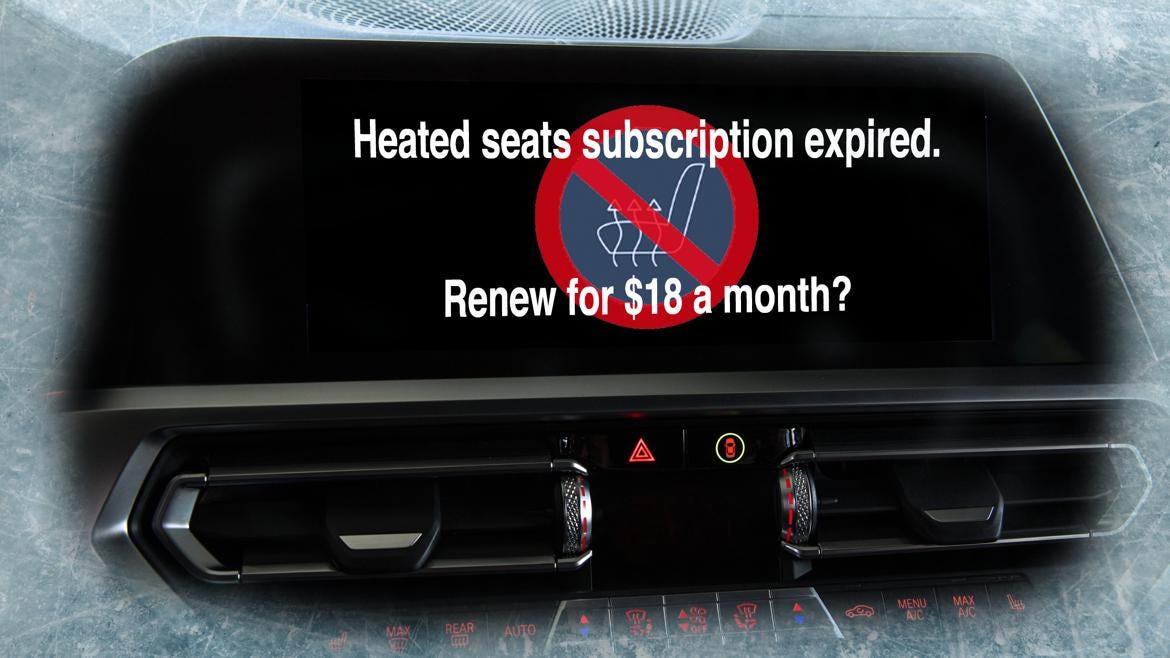
A few years ago, BMW rolled out an infamous experiment. They sold customers luxury cars physically fitted with heated seats. That is to say, the heating elements were already installed. The wiring was already run through the chassis. The button already existed on the dashboard. The hardware was physically sitting inside the vehicle. BMW had already spent the factory capital to manufacture it. The customer had already paid for the weight of the car. The seat was, in every meaningful sense, fully capable of warming your backside. The arse-warming technology was present. The bum infrastructure had been completed. The cheeks were standing at the border, ready to receive aid.
But if you wanted it to actually do so? That would be an additional monthly fee.
You would open an app on your phone. You would enter your credit card details. You would subscribe. And then, and only then, would a server in Munich beam a digital permission slip to your car allowing the electricity to travel four inches onto your ass. Electricity you already paid for when you filled the thing up with petrol.
Call me old-fashioned, but generally, when I buy a chair, I expect the chair to perform all of the chair-related activities immediately! I do not expect to discover that one of its cushions has entered into a separate contractual relationship with a German conglomerate!
I don’t want to find out that my left buttock has a direct debit set up with a Bavarian board of directors just to avoid frostbite on the M4 in February.
When it came time to derive the findings of this experiment, BMW’s team came to a shocking conclusion: people absolutely hated it. And I mean genuinely hated it. Consumers will tolerate a surprising amount of nonsense. Price increases? Unfortunately, yes. Complicated financing packages? Apparently yes. Paying extra for metallic paint even though the car is already made of metal? Yes. The salesman giving you a nipple cripple and calling you a pussy if you don’t want the turbo charged engine?...well maybe that’s just me, but anyways…
Consumers instinctively understand the difference between paying for an ongoing service and paying a ransom on an object they already bought. But tell someone their heated seat already exists and they must pay rent on the button? Suddenly you’ve recreated the French Revolution with leather upholstery.
So, BMW eventually backed away from the idea. One of the few remaining examples of modern consumers collectively saying: “No. Absolutely not. Fuck right off.” “Fuck Nein.”
But it’s not just BMW. You can buy motorcycle jackets now with subscription-based airbags; you pay £12 a month every month for the luxury of your airbag deploying. Cancel the payment, or run out of money, and they are more than happy for you to cartwheel to your death and smear yourself on the tarmac like a big fleshy crayon. The punishment for cancelling your service is death. Where’s the “double thank-you” there?
The automotive industry is hardly alone. Everyone’s at it. The home-printing industry has spent years trying to perfect its own version of subscription dependency. Customers of HP have repeatedly found themselves in a Mexican stand-off with their fax machine, where if you cancel your monthly ink subscription, the printer will actively lock the cartridges you already have in your house, refusing to print your documents.
Your printer has become a tiny plastic tyrant. It sits in the corner of your spare room going: “Lovely boarding pass you’ve got there. Shame if someone refused to print it unless you… restored your subscription.”
Think about that! What should be a simple home appliance somehow develops the hostile complexity of an international hostage negotiation!
And once you start noticing this trend, you see it everywhere. Smart thermostats. Security cameras. Fitness trackers. Doorbells. Products that once performed a straightforward mechanical function are increasingly connected to accounts, memberships, renewals, and terms of service documents longer than Tolstoy’s first draft of War And Peace.
A doorbell used to be a button that went ding-dong. Now it’s a surveillance weapon employed by the CCP.
Your fridge needs an app. Your hoover needs Wi-Fi. Your toothbrush is sending analytics to California like, “Geoff’s gums are underperforming this quarter.”
The goal is to transform ownership itself. To create a world where purchasing something is no longer the end of a transaction, but merely the beginning of a billing relationship. Because the modern corporate fantasy is that you never actually buy an appliance—you spend the rest of your life paying a subscription fee to your own toaster. And when you’ve had enough of this, you can’t even take it in the bath with you because that feature requires a premium tier!
Part 5: The Vampire Economy
We know why they do it. The question is, why do we let them?
It’s called The Vampire Economy.
Long ago, corporations recognised a fundamental, irrational aspect of human psychology: we are 1) lazy and 2) forgetful.
When you buy a physical item for £50, your brain registers the pain of that transaction immediately. You see the cash leave your wallet. It hurts. That pain registers as a “Don’t do it again.” However, when you sign up for a £7.99 monthly subscription, your brain processes it as a negligible, trivial expense. It’s “just the price of a coffee a day,” as the marketing ghouls love to tell us in their promotional emails.
Everything is “the price of a coffee a day.” Spotify is a coffee a day. Netflix is a coffee a day. My gym is a coffee a day. According to my bank statement, I am drinking forty coffees a day. I should be dead. From anxiety. My heart should have detonated in Pret A Manger weeks ago.
7.99 sounds pretty good as a one-off, but a one-off 12-times a year? It adds up, and you don’t even realise it.
Studies show that a supermajority of consumers underestimate how much they spend on subscriptions each month, often by a significant margin. Official UK government data shows there are around 155 million active subscriptions in the UK, with roughly 10 million classed as entirely unwanted. That means millions of people are actively paying for services they no longer use, or never intended to keep after a “free trial.”
“Cancel anytime” means: “Cancel anytime, provided you can find the hidden button after completing our online escape room.”
I’m talking about you, by the way. You are paying for fitness apps you haven’t opened since Liz Truss was briefly in office. You are paying for premium news websites you only clicked on once to read a single article about a stranded whale. You are paying for premium cloud storage for photos of an ex-partner you haven’t spoken to in seven years!
You’ve got a meditation app making you anxious, a sleep app keeping you awake, and a budgeting app charging you £6.99 a month to tell you you’re poor. Even though you still think about her every day. Just me…
Yes, Gary, she left! She’s not coming back! Delete the iCloud backup of the trip to Center Parcs, Gary! It’s over!
You’re not preserving the relationship. You’re paying Apple to keep a digital shrine of a woman called Emily who now does paddleboarding with a man named Ollie. Steve Jobs has cucked you again.
It is a passive, silent drain on your wealth. It is a vampire with fangs so sharp you don’t even feel the bite. A few times a month, he sneaks in while you sleep to suckle just a few drops of your blood, praying that you never wake up and look closely at your bank statement.
But you feel it. It’s called Subscription Fatigue. Industry data shows that nearly half of all consumers have actively cancelled a subscription in the last six months simply because they are entirely overwhelmed by how many they are paying for. We are suffering from pure subscription burnout.
Fortunately, governments are finally starting to crack down on subscription “traps.” In the UK, the Digital Markets, Competition and Consumers Act has stepped in to completely strengthen rules around transparency, mandatory renewal notices, and simplified cancellation processes. Regulators are actively pushing the principle that exiting a subscription must legally be exactly as easy as it was to join. Finally, maybe our government can do something right.
But even here, you know companies will find a way round it. “To cancel your subscription, simply click this link, upload a scan of your rectal cavity, solve a CAPTCHA showing every traffic light in Belgium, and defeat our retention goblin in single armed combat.”
But don’t wait for them. Here’s what you can do today.
Part 6: The Radical Act of Owning Your Stuff
Laws can only protect us so far. We have to change how we live. Because if we do not draw a line in the sand right now, the fat cats will win. They have designs on your life already: you will live in a rented apartment, sleeping on a subscription mattress, driving a car with paywalled steering, watching fragmented media on a leased television, while an AI assistant you rent for £30 a month manages the cancellation dates of your other eighty subscriptions.
And when you die, you’ll be in your pay-walled coffin, your grandkids huddled around the grave, frantically updating the card details, because if the payment fails, up you come.
If this mass-surveillance hell stresses you out, maybe Claude’ll give you a handjob. But nothing more; that’s exclusively for the premium enterprise tier.
There is an antidote to this madness. And it starts with a radical, almost revolutionary act: Buying things and keeping them.
Go out and buy physical media. If you love an album, buy the vinyl or the digital download from an independent site like Bandcamp. If you love a book, buy the physical pages bound in cardboard. Hey, buy my book for God’s sake! It’s printed on actual paper, it doesn’t require a terms of service update, and it works perfectly even if your Wi-Fi router catches fire!
You can drop it in the bath. You can use it to level a wonky table. You can even throw it at the police during the next inevitable summer riot. That’s real functionality.
And best of all, once you’ve bought it, I can’t charge you £4.99 a month to access Chapter Three. Actually, that’s not a bad idea.
Try this. Audit your bank statement tomorrow morning. Look for the vampires. Find the apps that are bleeding you dry for services you don’t use, and hit that cancel button. After that, hang garlic on your door and never, ever sign up for their bullshit again.
But seriously, buy my book!
You’ll own nothing and you’ll be happy. Easier to implement than people thought.
I will never give up my books, CDs, and DVDs; once streaming decides that an old movie is too offensive for today’s sensitivities, you’ll never find it again, but if you have it in your home in a physical copy, you can beat them. I never thought I’d by The Sandlot on DVD; one of the best family comedies of the 90s, but when people (or bots) on Amazon were saying that the movie promoted “rape culture” due to the lifeguard kiss prank scene, I knew that the networks would either censor it or put a million disclaimers on it. DVD purchase made without a second thought.
Ownership equals liberty, renting everything equals the lord giveth and the lord taketh. Always own stuff.
You got me laughing, Mr. Foster - especially the toaster bit.